Policy Literacy for the Creative Sector
An open-source policy brief educational template for creative workers and entities.

WHAT
Policy Literacy for the Creative Sector is an open-source policy brief educational template for creative workers and entities.
The template serves two primary purposes:
Provide baseline educational content on the intersection of the creative sector and public policy
Serve as an editable template and starting point for anyone who wishes to host regular policy briefs and learn and/or educate cohorts of people on cultural policy without having to develop and/or research the information from scratch.
Key content areas include:
The basics of how government works: from federal to municipal governments, to the basics of how bills become laws and how policy work occurs in the U.S. today, focused on application to the creative sector.
The role of government in the creative sector: from the history of government intervention in the creative sector, to the tools and players and current developments impacting the arts
Trusted tools and risk analysis for creative workers and entities: Ways to assess risk, consider your role and sphere of influence, identifying trusted resources, and actions you can take in support of the arts.
The Template is for anyone who wants to learn or teach cultural policy and advocacy.
It was designed especially for:
Affinity groups & cohorts of creative workers
Small-budget entities who may not have resources/ or staffing dedicated to cultural policy and advocacy
Students and anyone new to cultural policy and advocacy
Users can:
Learn by reading the template materials and watching the launch event video
Teach others with the template by editing the customizable materials for a specific audience
WHY
This template aims to support the creative sector’s ability to stay informed and take action amidst a volatile political moment.
Since the arrival of the COVID-19 pandemic, the arts and cultural sector has engaged in substantive advocacy and educational activity aimed at building stronger local networks in support of arts workers and entities. Impacted by the compounding realities of an already struggling arts ecosystem, the sudden loss of income, absence of a social safety net, and overall separation from larger labor movements, left arts workers and entities in dire straits. To address these needs, critical efforts like mutual aid networks, regranting collaborations, community organizing groups, and regular networking calls emerged as educational and resource redistribution life lines.
The resulting economic and sectoral crisis that has followed continues to highlight the need for arts workers and entities to better understand the role they play in the U.S. economy, the policies and structures that impact their everyday work, and the historical underpinnings that led them here. Anchored in the understanding that healthy communities need a strong cultural sector that preserves its citizen’s ability to engage in creativity and free expression, the Policy Literacy for the Creative Sector template aims to serve as an educational tool that strengthens the sector’s ability to engage in this learning and take action amidst a volatile political moment.
ACCESS
Download the template
The Policy Literacy for the Creative Sector Template includes three documents with researched content on the intersection of the creative sector and public policy. Each document includes a user guide and/or tips for editing. Download the template by completing the registration form and accepting the Terms of Use and Disclaimer below.
-
#1 Slide Deck (Google Sheets)
A ready-to-use Slide Deck designed to help you teach or present cultural policy concepts to cohorts of creative workers, arts organizations, or other groups. The file is fully editable so you can tailor the content to your audience and context.
-
#2 Sample Script (Google Docs)
This sample script is designed to be used side-by-side with the Template Slide Deck. It includes phrasing, talking points, and tips to help facilitators confidently lead sessions on policy literacy and engage participants effectively.
-
#3 Bibliography & Resource Library (PDF)
A curated collection of trusted sources, tools, and references designed to be used with the Template Slide Deck. It aims to help creative workers and entities find accurate information for research, advocacy, or program development.
FAQ
Frequently Asked Questions
-
Policy Literacy for the Creative Sector is an open-source customizable template that includes three documents with researched content on the intersection of the creative sector and public policy.
This includes:
the Slide Deck (Google Sheets)
the Sample Script (Google Docs)
the Bibliography & Resource Library (PDF)
Each document includes a user guide and/or tips for editing.
-
The Template is for anyone who wants to learn or teach cultural policy and advocacy.
It was designed especially for:
Affinity groups & cohorts of creative workers
Small-budget entities who may not have resources/ or staffing dedicated to cultural policy and advocacy
Students and anyone new to cultural policy and advocacy
Users can:
Learn by reading the template materials and watching the launch event video
Teach others with the template by editing the customizable materials for a specific audience
-
Creative workers and entities should help shape our democracy and future.
To do that, the template provides:
Baseline information on government, cultural policy, and some of the systems that shaped the landscape of the creative sector today
Guiding questions to help you interpret information and find trusted sources
A point of entry and guiding questions to find your place in policy and/or advocacy work, to organize, and to take action
-
In-depth information on every content area (Instead, think of it as a 101.)
Information on every geography, issue area, or role within in the creative sector—this is where you come in!
ADC Consulting’s or Scansion’s methodologies for advocacy or policy
Information on how to use data and research in advocacy or policy
A specific policy agenda
-
The Slide Deck and Script are made to be used within Google Suite; therefore, the accessibility features are based on what Google currently offers for Google Slides and Google Docs.
The Bibliography & Resource Library is in accessible PDF format, which includes alternative text for images and heading flow.
All files were designed using sans serif fonts and simple design elements. Body copy is Century Gothic, a commonly requested font for accessibility.
Slides have a predominantly white background with black text. Primary colors are used and WAG 3.1 color contrast guidelines were followed.
Slide descriptions are included in speaker notes and alternative text is included for all images and icons.
-
The template is free and available for download on ADC Consulting’s website: www.consultginadc.com/policytemplate.
To access the template users must:
Complete the download form.
Agree to the terms and conditions.
Download the files directly from the email sent to your inbox.
Please refrain from forwarding the email with the template links.
-
The Policy Literacy for the Creative Sector Template is an open-source policy brief educational template for creative workers and entities. The Policy Literacy for the Creative Sector Template is comprised of four files: a Slide Deck, Sample Script, User Guide, and Bibliography & Resources Library (“the Template”). By completing this form, accessing, using, or downloading the materials you accept and agree to be bound and abide by the following Terms of Use & Disclaimer. If you do not want to agree to these Terms of Use and Disclaimer, you must not access or use the Template.
Artificial Intelligence
You agree that you will not upload the contents of the Template into any Artificial Intelligence (A.I.) tools including but not limited to natural language processors, large language models, Chatbots, or other generative A.I. technologies (i.e., ChatGTP, Jasper Chat, Microsoft Copilot, etc.). This document contains material and information that is proprietary. Uploading this document or portions thereof into any A.I. tool is strictly prohibited and is not permitted under the license.
For Educational And Informational Purposes Only
The information contained in the Template is provided for informational purposes only, and should not be construed as legal advice on any subject matter. You should not act or refrain from acting on the basis of any content included herein without seeking legal or other professional advice. The information provided, including the Template, contain only general information and may not reflect current legal developments or address your situation. We disclaim all liability for actions you take or fail to take based on any content provided herein.
No Endorsements
From time to time, the Template and the Template’s Authors will refer to other products, services, coaches, consultants, experts, publications, and/or entities. Any such reference is not intended as an endorsement or statement that the information provided by the other party is accurate. The Authors provide this information as a reference for users. It is your responsibility to conduct your own investigation and make your own determination about any such products, services, coaches, consultants, experts, publications, and/or entities.
No Guarantees
You agree that the Authors of this Template have not made any guarantees about the results of taking any action, whether recommended on this Template or not. The Authors provide educational and informational resources that are intended to help users of this Template succeed in life, business, and otherwise. You nevertheless recognize that your ultimate success or failure will be the result of your own efforts, your particular situation, and innumerable other circumstances beyond the control and/or knowledge of the Authors. You also recognize that prior results do not guarantee a similar outcome. Thus, the results obtained by others, applying the principles set out in this Template are no guarantee that you or any other person or entity will be able to obtain similar results.
Copyright, Licensing & Crediting
By accessing and using this Template you affirm that you understand the copyright, licensing, and credit details outlined below and agree to properly credit the Template’s Authors as outlined below.
Unless noted otherwise, the Template is provided under the terms of the Creative Commons Attribution-NonCommercial 4.0 International License, as modified and explained below. The Template is protected by copyright and/or other applicable law. Any use of the Template other than as authorized under this license or copyright law is strictly prohibited.
Through this license you are free to:
Share — Copy and redistribute the material in any medium or format
Adapt— remix, transform, and build upon the materials.
The licensor cannot revoke these freedoms as long as you follow the license terms.
License terms include:
Attribution — You must give appropriate credit, provide a link to the license, and indicate if changes were made. You may do so in any reasonable manner, but not in any way that suggests the licensor endorses you or your use.
NonCommercial — You may not use the material for commercial purposes .
No additional restrictions — You may not apply legal terms or technological measures that legally restrict others from doing anything the license permits.
Notices:
You do not have to comply with the license for elements of the material in the public domain or where your use is permitted by an applicable exception or limitation .
No warranties are given. The license may not give you all of the permissions necessary for your intended use. For example, other rights such as publicity, privacy, or moral rights may limit how you use the material.
Crediting Language:
Long Form: Policy Literacy for the Creative Sector Template © 2025 ADC Consulting, LLC. Conceived and Created by: Alejandra Duque Cifuentes, ADC Consulting and David Holland, Scansion. Except where otherwise noted, content on this Template is licensed under a Creative Commons Attribution By NonCommercial 4.0 International license. Icons by Freepik.
Short Form: © 2025 ADC Consulting, LLC. Icons by Freepik. CC BY-NC 2025.
-
The Template was designed within Google Suite. If you do not have a Google Suite account, you will need to create one. If you are not able to use a Google Suite account, please contact us at admin@consultingadc.com and we will do our best to accommodate you as our resources allow.
Please note that some of the features and/or design elements of the Template might be lost when downloaded to or used with other software. The ADC Consulting Team will be unable to mitigate those impacts.
-
You can credit the authors by including a slide in your presentation or a disclaimer that says:
Except where otherwise noted, content on this Template is licensed under a Creative Commons Attribution By NonCommercial 4.0 International license. © 2025 ADC Consulting, LLC. Conceived and Created by: Alejandra Duque Cifuentes, ADC Consulting and David Holland, Scansion. Icons by Freepik.
To add an additional short form copyright credit you can include the following:
© 2025 ADC Consulting, LLC. Icons by Freepik. CC BY-NC 2025 -
Yes, please submit your resource by emailing us at admin@consultingadc.com.
Please note we cannot guarantee the inclusion of every resource and will only add resources as our capacity allows.
-
Yes! We would love to offer a policy brief and/or lead a workshop with your organization and/or students. Please schedule a discovery call and/or contact us at admin@consultingadc.com.
-
Please contact us at admin@consultingadc.com and we will do our best to address your concerns as our resources allow.
QUARTERLY NATIONAL POLICY UPDATES
Policy Literacy for the Creative Sector: National Policy Updates
We host digital quarterly National Policy Updates. Our last one was on Friday, April 24, 2026. Facilitated by Alejandra Duque Cifuentes of ADC Consulting and David Holland of Scansion, Policy Literacy for the Creative Sector: National Policy Update uses our recently released Policy Literacy for the Creative Sector educational template.
The event includes:
A brief on current federal policies and the creative sector;
Overview on how to identify local advocacy efforts and organizations near you; and
A refresher on how to access and modify the template for ongoing learning and organizing.
ASL Interpretation and CART are provided. Registration is free and required.
Upcoming Quarterly National Policy Update: August 2026
Stay tuned for registration details!


Alejandra Duque Cifuentes
ADC Consulting
David Holland
Scansion
WATCH
Replay the launch event video
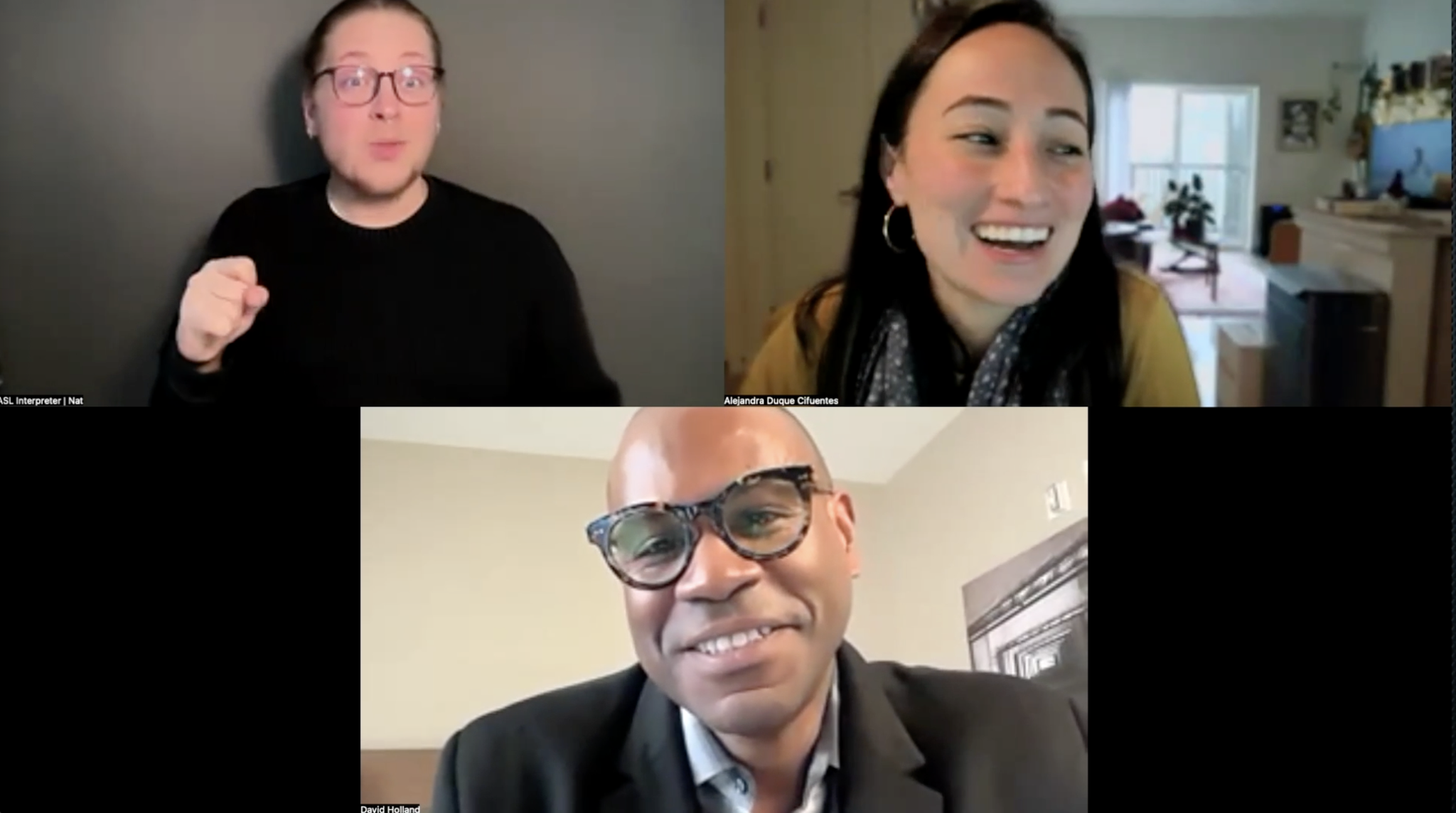
On Tuesday, November 18, 2025 from 3:00 p.m. - 5:00 p.m. ET, ADC Consulting and collaborators gathered for the public launch of the Policy Literacy for the Creative Sector template.
Facilitated by Alejandra Duque Cifuentes of ADC Consulting and David Holland of Scansion, the event included an introduction to the template tool, ways creative workers and entities can use it, and a sample policy brief on the state of the creative sector in the context of the current political moment. ASL Interpretation was provided live during the event by SignNexus and CART was provided by the Viscardi Center.
Acknowledgements
CONCEIVED & CREATED BY
Alejandra Duque Cifuentes, Founder & Principal, ADC Consulting
David Holland, Senior Partner, Scansion
DESIGN & LAYOUT
Susana Baker, Founder & Creative Director, Untangling Ideas
Sofía Mejía Diez, Graphic Designer, Untangling Ideas
Suzette Sagisi, Copy Editor
Icons by Freepik
ADMINISTRATION & NOTATION SUPPORT
Augustine Jimenez, Administrative Consultant, ADC Consulting
Brinda Guha, Production & Marketing Consultant, ADC Consulting
Maleni Palacios, Operations & Client Services Consultant, ADC Consulting
EVENT MANAGEMENT SUPPORT
Candace Thompson-Zachery, Production & Organizational Management Consultant, ADC Consulting
Ellie Moscati, hww.work
Special thanks to our colleagues at the Creative States Coalition, Creative West, and the National Arts Policy Alliance for your leadership in arts advocacy and cultural policy.
© 2025 ADC Consulting, LLC. Conceived and Created by: Alejandra Duque Cifuentes, ADC Consulting and David Holland, Scansion. Except where otherwise noted, content on the Policy Literacy for the Creative Sector Template is licensed under a Creative Commons Attribution By NonCommercial 4.0 International license. Icons by Freepik.